

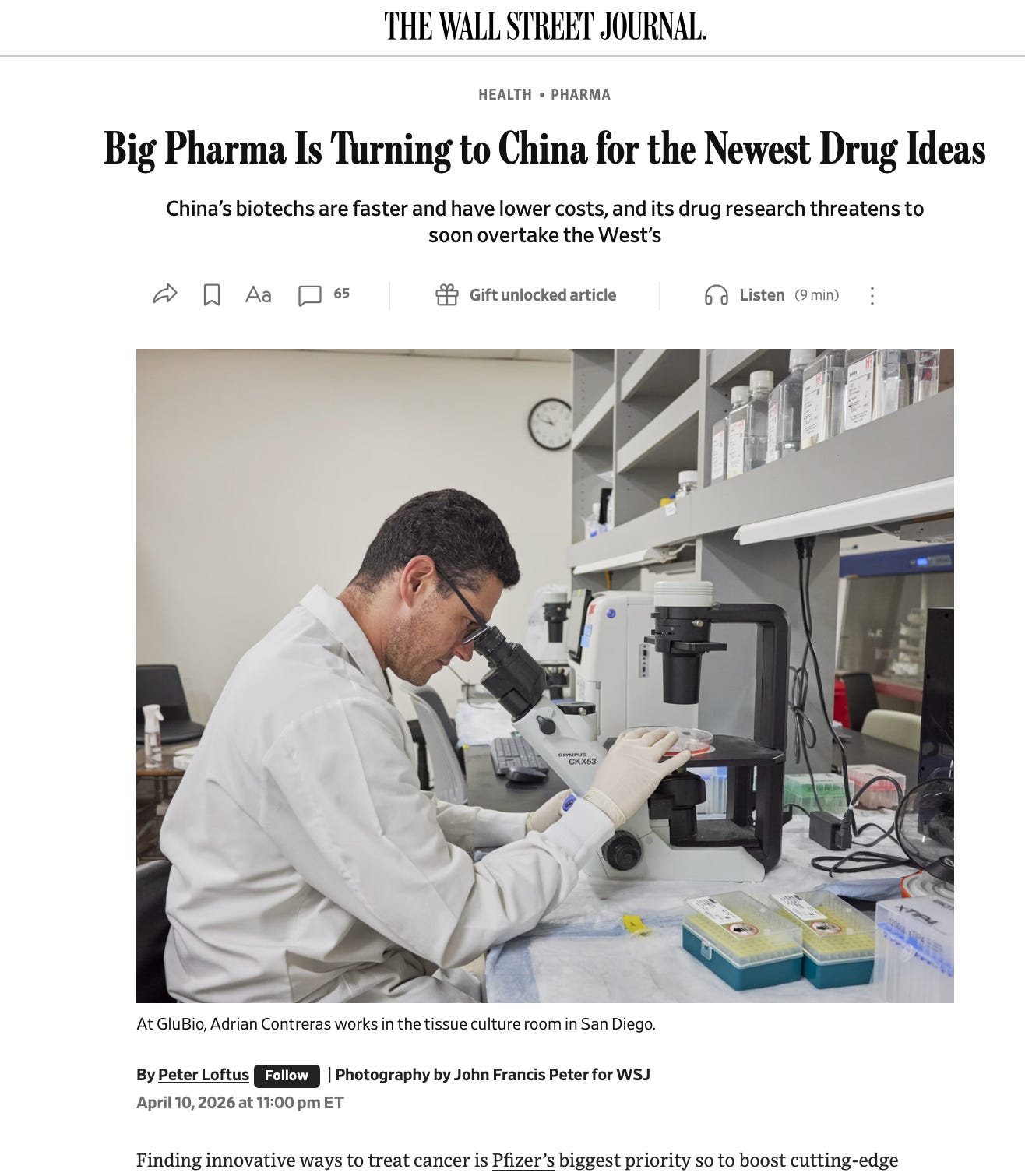
WSJ article [paywall]
Yes, Western pharma spent nearly $5.6 billion licensing Chinese drug candidates last year. Yes, China now represents 30% of the global experimental pipeline. But before we declare a dynasty change in biopharma, let’s ask a harder question:
Is this innovation — or sophisticated iteration?
Look closely at what Chinese biotechs are actually doing. They are extraordinarily good at:
Scanning Western patent filings and published research within days of release
Identifying structural wrinkles and freedom-to-operate gaps
Running efficient, low-cost chemistry to produce “me-better” variants
Moving rapidly through clinical stages using China’s regulatory shortcuts and patient pools
That is genuinely impressive execution. But it is not the same as discovering a new mechanism, identifying a novel target, or taking a truly first-in-class molecule from concept to clinic. Reverse engineering at scale is a business achievement — not a scientific one.
The molecular glue story in the article makes this plain: Chinese scouts analyzed a Novartis paper, published a how-to guide within four days, and biotechs went to work improving on what Western companies had already invented. That’s speed and efficiency. It is not leadership.
The domestic paradox no one is discussing.
China is producing medicines it largely cannot afford to buy. The high-cost biologics, ADCs, and GLP-1 therapies flowing out of Chinese labs are priced for Western markets — not for the 1.4 billion people at home. A nation building an export-dependent biotech sector on drugs its own population cannot access is not a model of strength. It is a structural vulnerability.
The real risk isn’t losing to China. It’s becoming dependent on it.
US biotechs licensing Chinese “me-better” compounds get a short-term pipeline win — cheaper assets, faster timelines. But over time, this pattern could hollow out early-stage domestic R&D, create supply chain dependencies, and train the industry to reach for the easy incremental gain rather than do the harder, riskier work of genuine first-in-class innovation.
The US doesn’t need to fear Chinese biotech dominance. It needs to avoid outsourcing its scientific ambition to it.
China has world-class scientists, enormous capital, and real government commitment. When it chooses to invest in true de novo discovery — not just optimizing what others have found — it will be a formidable force. Until then, calling this an impending takeover of Western biopharma is flattering to China and alarmist to everyone else.
The WSJ piece was a good story. It was not the whole story.
#DrugDiscovery #Biotech #Pharma #ChinaBiotech #Innovation #LifeSciences #BiopharmStrategy #MediumTerm