
The Mandelbrot Boundary: The Non-Linear Geometry of Clinical Trial Failure
Why your trial is an iterative dynamical system, not a spreadsheet

This is the definitive, expanded version of my earlier post. I have deepened the historical narrative, added the “Coastline Paradox” in greater detail, and explored the “Butterfly Effect” of the initial site activation sequence. This version is designed to be a true “long-read” for the intellectually curious executive, pushing into the 1,500-word range.
The High Cost of Euclidean Thinking
There is a particular kind of silence that fills a boardroom about fourteen months into a Phase 3 trial. The enrollment forecast has been revised three times. The “Site Rescue” task force has stopped asking why sites are behind and started negotiating how much the timeline must shift. In this room, everyone is an expert. The sites are world-class, the CRO is reputable, and the clinical leads are tireless.
Yet the trial is in trouble—structurally, irreversibly.
The traditional response is to double down on “linear” solutions: hire more CRAs, add more sites, or increase the recruitment budget. This approach assumes that a clinical trial is a Euclidean machine—a system where inputs and outputs share a proportional, straight-line relationship. In the Euclidean worldview, if you are 10% behind, you simply need 10% more effort to catch up.
But clinical trials are not machines. They are non-linear dynamical systems. They are iterative feedback loops where the output of Month 1 (enrollment, safety signals, site engagement) becomes the input for Month 2. In mathematics, when you iterate a non-linear function, you don’t get a straight line; you get a fractal.
If your trial is too slow, it isn’t because you lack “effort.” It’s because your operational parameters have drifted into a region of mathematical chaos. To understand how to navigate this, we must look at the geometry of fate.
I. Gaston Julia and the Ghost in the Execution
The History of the Leather Mask
In 1918, amidst the ruins of post-WWI France, a mathematician named Gaston Julia published a 199-page masterpiece on the iteration of rational functions. Julia was a war hero who had lost his nose in the trenches; he wore a leather mask for the rest of his life. Working without computers, Julia (and his contemporary Pierre Fatou) visualized a world where simple equations could produce boundaries of infinite complexity.
For a fixed protocol configuration (a constant c), the Julia set is the boundary of the set of starting points z0 that do not escape to infinity under the iteration:
The Clinical Parallel: Sensitivity to Initial Conditions
In this equation, z0represents your starting conditions. This is the specific sequence of your first ten sites, your initial patient cohort, and your first regulatory green light.
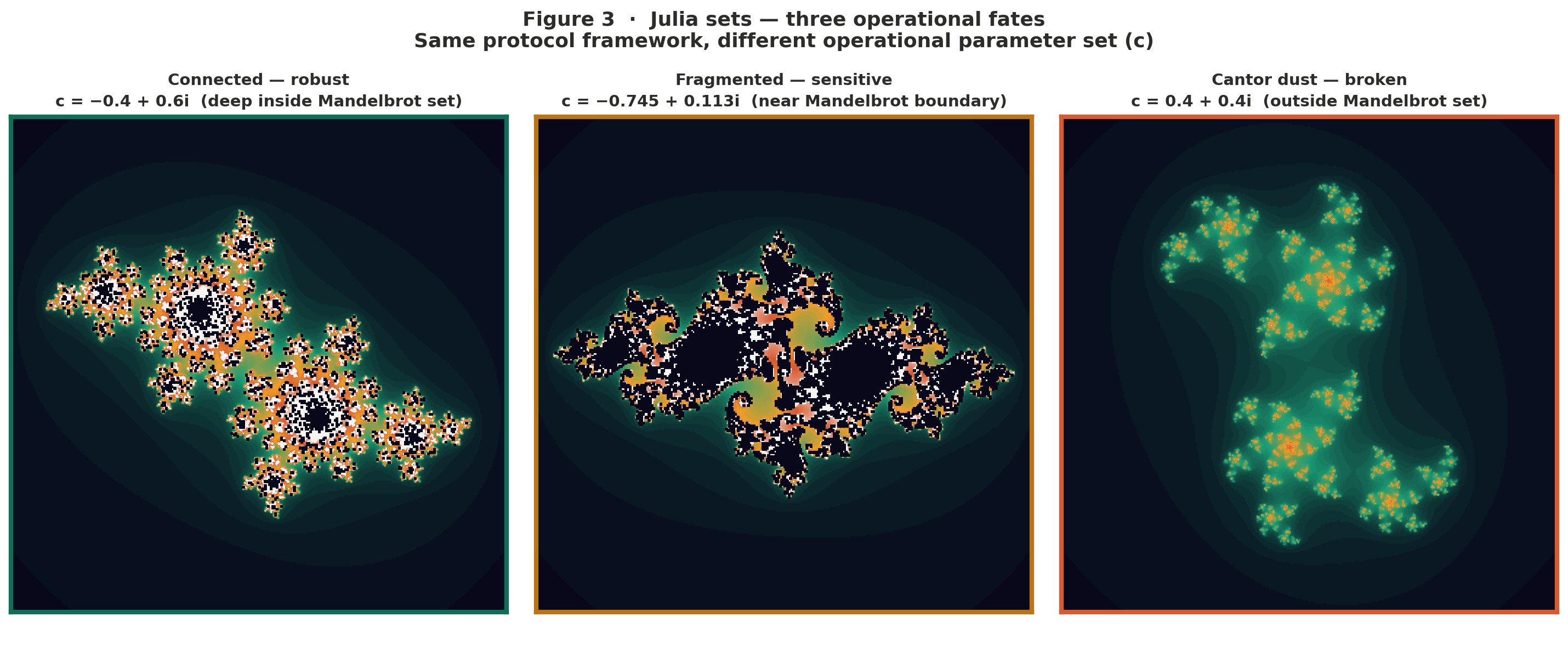
Connected Julia Sets (Robustness): When your protocol (c) is stable, the Julia set is a “connected” shape. This means the outcome is robust. Whether Site A or Site B activates first, the system stays within the “basin” of success.
Cantor Dust (The Fragmented Trial): If the protocol is slightly off, the Julia set shatters into “dust.” Success becomes hyper-sensitive to z_0. This is the Butterfly Effect of operations. If your high-enrolling site opens on a Tuesday, you succeed. If they open on a Wednesday, the whole program “diverges to infinity” (fails).
Most “failed” trials were actually “Cantor Dust” executions. The protocol was so fragile that only a perfect, impossible sequence of events could have led to a positive readout. We blame “bad luck,” but the math tells us the failure was baked into the starting geometry. Here is a graphic from a recent blog post
II. Pierre Fatou and the Gravity of Failure
The Discovery of Attractors
While Julia looked at the boundary (chaos), his contemporary Pierre Fatou—working in isolation at the Paris Observatory—explored the interior. Fatou was arguably the first to understand Basins of Attraction.
The Math: The Fatou Set (F(f))
The Fatou set is the region where behavior is stable. Within it lie attractors. An “attractor” is a state toward which the system naturally evolves. If a point z is in a basin B(L), then:
The Clinical Parallel: The Three Basins of Fate
A clinical trial is essentially a point moving through a high-dimensional space, pulled by three primary “Fatou Basins”:
The Success Basin: Operational and biological variables converge toward a clean, statistically significant readout.
The Futility Basin: The noise of the data eventually overwhelms the signal, regardless of how many patients you add.
The Toxicity Basin: The system “escapes” to a state of unacceptable risk.
The Insight: Most trials fail because they are launched in the “Julia Set”—the razor-thin boundary between basins. In the Julia set, the trial is unstable. A single outlier patient can knock the entire program out of the Success Basin and into the Futility Basin. Fatou’s theorem in mathematics teaches us that stability is a property of the initial coordinates, not just of the effort applied during the journey.
III. The Mandelbrot Set: The Map of the Possible
The History: IBM and the Thumbprint of God
Sixty years after Julia and Fatou, Benoit Mandelbrot used early computer graphics to plot all the possible Julia sets on a single graph. He discovered the most complex object in mathematics: the Mandelbrot Set.
The Math: Mapping Parameter c
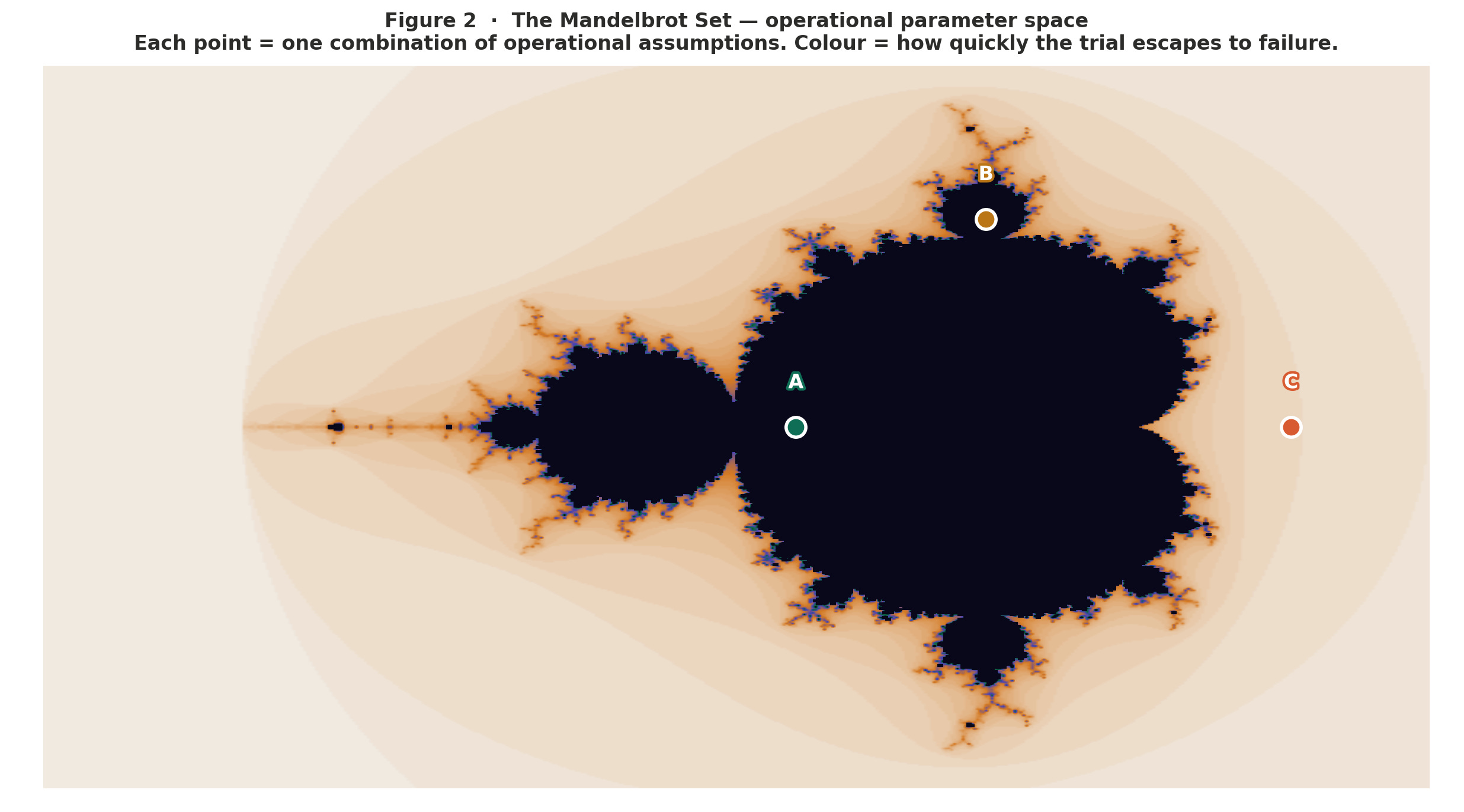
The Mandelbrot set is the set of all protocol configurations (c) for which the Julia set is connected. It is defined by iterating from z_0 = 0:
The Clinical Parallel: Protocol Topology
Every point c on the map represents a different combination of inclusion criteria, primary endpoints, and dosing regimens.
The Black Heart: If your protocol (c) is in the middle of the set, you are safe. You have built a “connected” path to success.
The Seahorse Valleys: If you are on the “fringes”—the “Seahorse Valleys” of the Mandelbrot set—your trial is technically viable but infinitely complex. A tiny change in the competitive landscape or a minor regulatory tweak moves you out of the set, and your trial “diverges.”
The failure of modern drug development is that we spend all our time managing z_n (the execution) and zero time calculating where our c (the protocol) sits on the map of stability.
IV. Fractal Time and the Coastline Paradox
The History: Richardson’s Ruler
In the 1950s, Lewis Fry Richardson noticed that the length of the border between Spain and Portugal changed depending on who was measuring it. If you use a 1-km ruler, the border is short. If you use a 1-meter ruler, the border “grows” because you are now measuring every rock and inlet.
The Math: The Fractal Dimension (D)
The measured length L follows a power law:
As the ruler ‘epsilon’ gets smaller, the length L increases.
The Clinical Parallel: Why the Last 10% Takes 50% of the Time
At the start of a trial, we measure progress with a “large ruler” (e.g., “Open 50 sites”). It looks simple. But as we approach Database Lock, we switch to a “microscopic ruler” (e.g., “Reconcile the SAE on Patient 104-02”).
As the “ruler” gets smaller, the amount of work increases exponentially. This is why the final 10% takes 50% of the time: you have increased the resolution of the project, and in doing so, you have discovered the infinite complexity of the fractal edge. This is Fractal Time. You aren’t “almost done”; you are simply looking closer at an infinite coastline. To a Euclidean manager, this appears to be a delay. To a Fractal manager, this is just the nature of closing a complex system.
V. Other Applications: The Fractal Body and Pink Noise
The reason non-linear dynamics are so relevant to medicine is that the human body itself is a fractal masterpiece. 1. Fractal Physiology: Our lungs and vasculature are branching fractals.
This allows massive surface area (for oxygen exchange or drug absorption) to fit into a finite 3D volume. When we dose a drug, we aren’t dosing a “cylinder”; we are dosing a branching network. If the drug’s diffusion constant doesn’t match the fractal dimension of the tissue, the Phase 3 trial will fail despite Phase 1 success.
2. Oncology and Chaos: Tumor growth is non-linear. The “Fractal Dimension” of tumor margins is now used as a biomarker. Smooth margins (low D) imply stability; highly fragmented margins (high D) imply aggressive, chaotic invasion.
3. Financial “Fat Tails”: Mandelbrot proved markets follow Power Laws, not Bell Curves. Biotech portfolios suffer from “fat tail” risks where “impossible” crashes happen far more often than linear models predict. Trials don’t just “underperform”; they “jump” from one Fatou basin to another.
Conclusion: The “So What” – The Operational Topologist
The lesson of Fatou, Julia, and Mandelbrot is that boundaries are more important than averages.
In clinical development, we are obsessed with averages: average enrollment, average p-values, average site performance. But averages only matter in linear systems. In a non-linear system, the only thing that matters is where the boundary lies.
Calculate Parameter Distance: Before spending $200M, ask: “How close is our protocol (c) to the Mandelbrot boundary?” If a 10% change in screen failure rate pushes you into the “Chaos Zone,” your protocol is structurally flawed.
Map the Basin: Stop asking if sites are “doing a good job.” Ask if the system has fallen into a “Futility Basin.” If the feedback loops are generating more queries than they are resolving, you are in a divergent orbit.
Force a Lower Resolution: To escape the “Coastline Paradox” at the end of a trial, you must stop shrinking your ruler. You must define a “closure resolution” (e.g., frozen data snapshots) early, or you will be measuring the coastline forever.
Identify the Branch: In a fractal system, a problem at the “Patient Level” is usually just a high-resolution version of a “Leadership Level” failure. Zoom out. Fix the branch, not the leaf.
The future of drug development belongs to the Operational Topologist. They will understand that a trial doesn’t fail because people didn’t work hard enough. It fails because it was placed in a region of the map where failure is the only mathematical attractor.
Know your boundary, or the boundary will find you.
“Beautiful and chaotic things exist on the same boundary. The job of the executive is to keep the program in the heart.”