

For small biotech companies, the journey of drug development is often a high-stakes, tightrope walk, balancing scarce resources against the immense challenge of bringing novel therapies to patients. In this environment, innovation isn't just about discovering new molecules; it's equally about pioneering smarter, more efficient ways to demonstrate their value. The recent re-evaluation of imatinib for Pulmonary Arterial Hypertension (PAH) serves as a powerful case study—a testament to how innovative trial design can make a smaller Proof-of-Concept not just feasible, but incredibly insightful, offering a vital blueprint for lean drug development.
Imatinib, an established drug, had previously shown promise in PAH by targeting key disease pathways. However, its journey was cut short after the large, traditional IMPRES Phase 3 trial, which tested a 400mg daily dose, revealed significant tolerability and safety issues, effectively sidelining it for this indication (see table below). Many would have closed the book. But the innovative spark in its revival, detailed in the Rothman and colleagues' study, was the decision not to discard the drug, but to meticulously re-investigate its fundamental challenge: the therapeutic window. This targeted approach, focusing on identifying a lower, yet still effective, tolerable dose (200mg daily), demonstrates a crucial lesson: initial setbacks, especially dose-related ones, can be overcome with intelligent, focused reassessment —a strategy particularly valuable for biotechs aiming to maximize the potential of their assets.
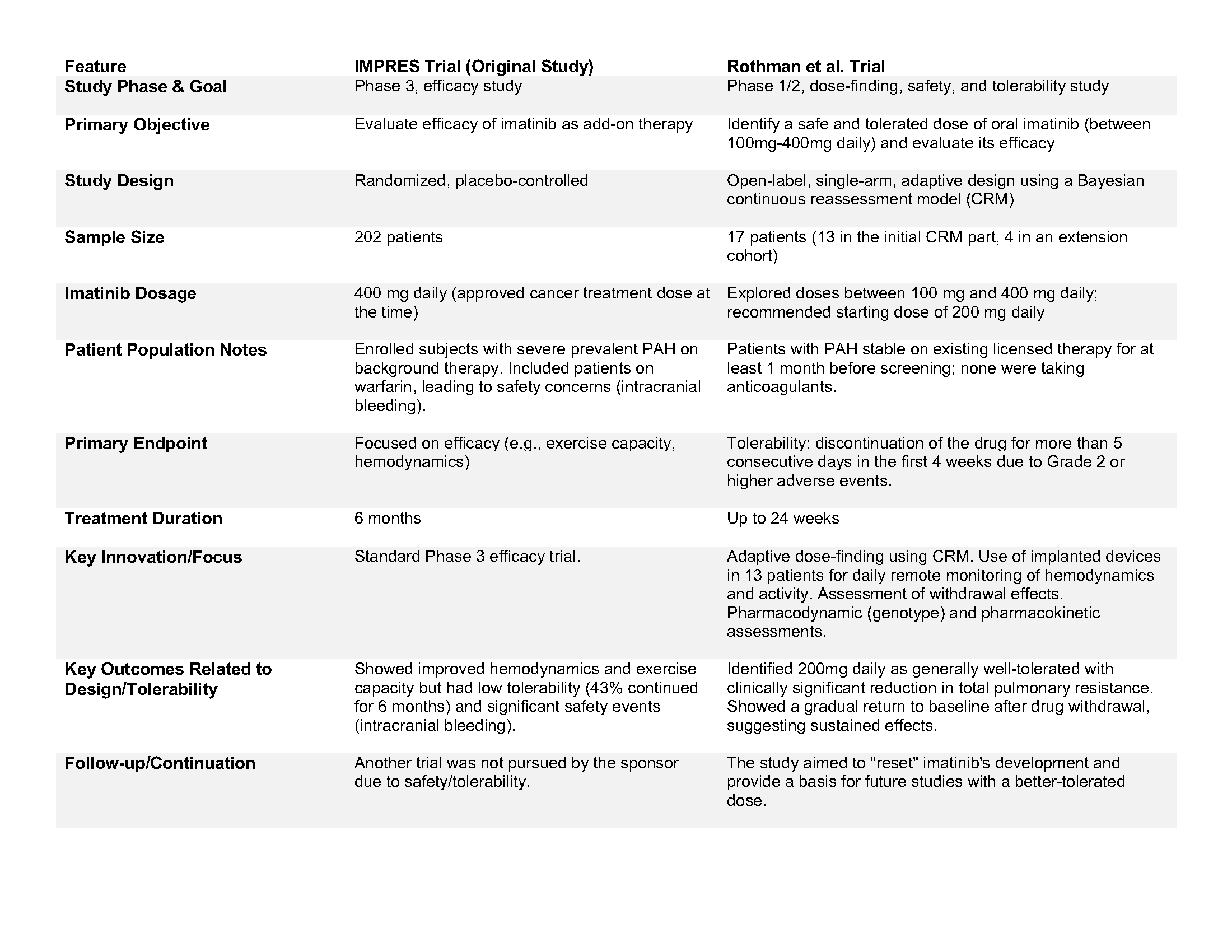
The true game-changer, however, and the core of its utility as a model for PoC, was the innovative architecture of the Rothman trial. This was not a scaled-down version of a traditional trial; it was a fundamentally different, more agile approach that yielded convincing data from just 17 patients, a stark contrast to IMPRES's 202:
Adaptive Design for Lean PoC (The Bayesian CRM): The study employed a Bayesian Continuous Reassessment Model. This statistical method is inherently adaptive, meaning the trial "learns" in real time. The optimal dose for subsequent patients is determined based on accruing safety and tolerability data from those already enrolled. For a PoC study, this innovation is transformative. It allows for efficient dose exploration and identification with a minimal number of patients, drastically reducing timelines and costs while also being more ethical by limiting exposure to ineffective or poorly tolerated doses. This demonstrated that robust dose-finding, a key PoC element, doesn't invariably demand large numbers.
Deep Insights from Rich Data (Implanted Sensors): Thirteen patients were equipped with implantable devices providing continuous, daily hemodynamic and activity data. This innovative integration of remote monitoring technology into an early-phase trial yielded a depth of information far exceeding what's typical. Instead of relying on infrequent clinic visits, researchers could observe the nuanced effects of imatinib—its gradual onset, its impact on daily life metrics, and, critically, the drug’s behavior upon withdrawal. This allowed for a robust characterization of the drug's effects from a small cohort, powerfully enhancing the "proof" in the PoC.
Strategic Learning & Focus: The trial design explicitly learned from the past. Patients on anticoagulants, a source of safety concerns in IMPRES, were excluded. The primary endpoint was clearly focused on tolerability, directly addressing the major hurdle identified in previous research. This strategic clarity ensured the small trial answered the most pressing questions efficiently.
From this innovative PoC approach, we learned that small, intelligently designed studies can be extraordinarily powerful. They can provide clear, actionable answers, de-risk further development, and offer a more compelling early data package than larger, less focused efforts might. The depth and continuity of data can often outweigh sheer patient numbers in early validation.
For small biotech drug developers, the lessons from imatinib's revival are particularly salient:
Lean PoC is Achievable: Don't assume that impactful PoC requires massive investment in large patient cohorts. Smart design can deliver convincing results efficiently.
Adaptive Designs are an Asset: Embrace adaptive methodologies like CRM. They optimize resource allocation (patients, time, capital) and maximize the learning from every data point.
Technology as a PoC Enhancer: Leverage modern tools like wearables and implantable sensors. They can provide the rich, longitudinal data needed to make a strong case from smaller studies, attracting partnerships and investment.
Strategic Re-evaluation Unlocks Value: If an asset with a sound scientific rationale has previously stumbled, particularly on dose or tolerability, an innovative, targeted PoC might be the key to unlocking its hidden value.
Focused Questions, Efficient Answers: Design PoC trials to answer the most critical questions head-on, as the Rothman study did with imatinib's dose-tolerability.
The story of imatinib in PAH, as retold through the lens of the Rothman trial, is far more than an academic exercise. It's a practical demonstration that innovation in trial design can yield profound results with remarkable efficiency. For small biotechs striving to make big impacts with limited resources, this "lean and keen" approach to Proof-of-Concept isn't just an option; it's a strategic imperative for success.
#SmallBiotech #ProofOfConcept #PAH #TrialDesign #DrugDevelopment #Innovation #RareDisease