

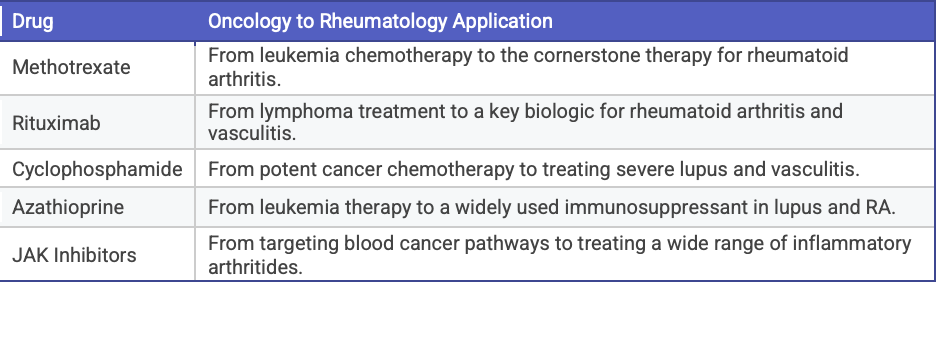
The cross-pollination of therapeutic concepts between different medical fields is a powerful engine for innovation (Table). This path is well-trodden; cornerstone therapies in rheumatology, such as methotrexate and rituximab, were first developed and utilized in oncology before finding profound success in treating autoimmune diseases.
A novel agent in this class, VEGF-Grab (also known as PB101), is currently in early-stage clinical trials for the treatment of advanced solid tumors and has not yet been approved for any disease indication. While its primary development is in oncology, its mechanism presents a compelling rationale for exploring its use in autoimmune diseases, such as rheumatoid arthritis (RA).
The inflamed synovium in RA is, in many ways, like a tumor: it is a hyper-proliferative, invasive tissue that relies on pathological angiogenesis to sustain its growth and import inflammatory cells, thereby perpetuating joint destruction. Targeting this process is a logical, if underexplored, therapeutic strategy.
A recent abstract from the EULAR 2025 congress (@Hee-Young Lee et al) explores this very concept, investigating VEGF-Grab as a dual inhibitor of both VEGF and Placental Growth Factor (PIGF). PIGF is a key player in autoimmunity, known to promote pathogenic angiogenesis and inflammation.
The preclinical findings presented are noteworthy:
Mechanism of Action: VEGF-Grab is an Fc fusion protein designed to block VEGF and PIGF. An improved version demonstrated enhanced stability, a longer half-life, and increased binding affinity.
In Vitro & Cellular Effects: The therapy effectively reduced PIGF-mediated endothelial cell migration and tube formation. Crucially, it suppressed the migration of RA fibroblast-like synoviocytes (RA-FLSs) and inhibited the differentiation and maintenance of pathogenic Th17 cells.
In Vivo Efficacy: In animal models of arthritis, treatment led to a significant reduction in inflammation, pannus formation, and joint destruction. Furthermore, in a mouse model of multiple sclerosis, it enhanced the therapeutic effects of standard IFN-β treatment.
Implications for Drug Developers
While this dual-targeting approach, which simultaneously addresses angiogenesis and inflammatory cell activity, is intellectually appealing, a cautious perspective is warranted. These are promising preclinical data from animal models. The path to demonstrating safety and convincing efficacy in human subjects with complex autoimmune diseases is challenging and fraught with uncertainty. Key questions regarding long-term safety, potential impacts on physiological angiogenesis, and patient selection criteria remain unanswered. This is a promising first step, but a long journey lies ahead.
#DrugDevelopment #Rheumatology #Autoimmunity #Oncology #VEGF #EULAR2025 #TranslationalMedicine