

Remember the Atkins diet? For many, it conjures images of endless bacon, butter, and a strict ban on anything that even looked like a carb. It was the diet that famously told you to "eat the hamburger and throw away the bun," a mantra that simultaneously thrilled and horrified. For decades, Dr. Robert Atkins, the cardiologist behind this revolutionary (and deeply controversial) approach, was largely dismissed as a quack, a faddist, or worse, by the very medical establishment he sought to challenge. This rigid dismissal contributed to a growing public skepticism towards mainstream health advice. It certainly didn't help foster trust. Let's peel back the layers of this fascinating dietary saga and perhaps, in doing so, find a little empathy for the man who dared to defy conventional wisdom.
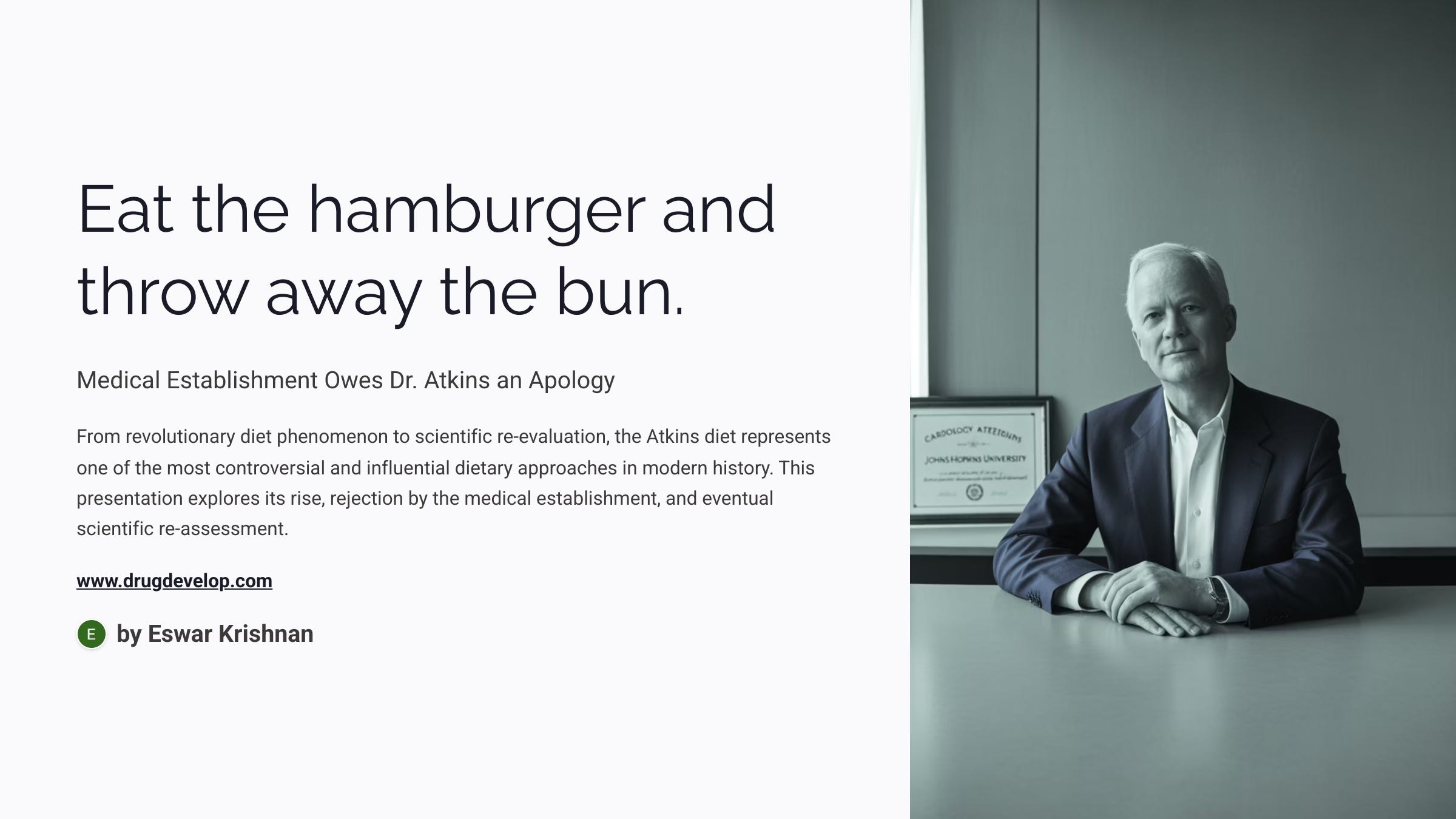
The Maverick Physician: A Personal Crusade
Dr. Robert Atkins wasn't some detached academic. He was a physician, a cardiologist, who, like so many of us, grappled with his own weight. This personal struggle became the crucible for his professional passion. He delved into existing research, notably influenced by Alfred W. Pennington's low-carbohydrate work from the World War II era. This wasn't a completely new idea. In 1959, he opened his private practice in New York City, specializing in both cardiology and complementary medicine. He was looking for answers.
His ideas truly took flight with the publication of Dr. Atkins' Diet Revolution in 1972. This book, and its 1992 reissue, Dr. Atkins' New Diet Revolution, became an absolute sensation. It sold an astonishing 12 million copies. Think about that for a moment: 12 million copies! It cemented its place as one of the bestselling diet books in history. It was even one of the top 50 best-selling books across all genres. By the early 2000s, an estimated 1 in 11 North American adults claimed to be following its principles. This wasn't just a diet; it was a cultural phenomenon.
Atkins' core premise was disarmingly simple, yet radical for its time: drastically cut carbohydrates, and your body would shift into a fat-burning mode, leading to weight loss. He even posited a "metabolic advantage." He claimed that "burning fat takes more calories so you expend more calories." This, he argued, offered "a high calorie way to stay thin forever." This meant loading up on meat, cheese, eggs, butter, and mayonnaise. It meant saying a firm no to bread, pasta, cereals, and most fruits and starchy vegetables. It was a complete reversal of the low-fat dogma of the era.
From Fad to Franchise: Bypassing the Establishment
So, how did a diet that flew in the face of conventional wisdom become so incredibly popular? Dr. Atkins was a master of direct appeal. When the mainstream medical community largely rejected his unconventional ideas, he simply bypassed them. He went straight to the public. This wasn't just a marketing tactic. It was a deliberate choice that resonated deeply with his followers. They saw him as a "courageous David standing up to the establishment Goliath." This perception, fueled by his bestselling books, allowed his message to bypass traditional gatekeepers. It reached millions.
He didn't stop at books. In 1989, Atkins founded Atkins Nutritionals, Inc. This wasn't just about selling books. It was about building an empire. The company marketed and sold Atkins-branded low-carb foods and supplements. Crucially, it also generated revenue for further research into his nutritional protocols. This commercial arm, coupled with extensive media coverage and late
r celebrity endorsements from figures like Kim Kardashian, Rob Lowe, and Wanda Sykes, propelled the Atkins brand into the stratosphere. It was a smart business move.
However, this direct-to-consumer approach came with a significant Achilles' heel: Atkins largely failed to publish rigorous clinical data on his patients in peer-reviewed journals. This absence of scientific validation became a significant point of contention. It led to accusations of making "unsupported statements about health." This lack of traditional scientific rigor, combined with his commercial success, only deepened the chasm between Atkins and the medical establishment. The stage was set for a monumental clash.
The Storm of Scorn: "Unbalanced, Unsound, Unsafe"
The medical establishment's reaction to the Atkins diet was swift, severe, and almost universally condemnatory. It was consistently "dismissed as a faddist or worse by most mainstream experts." It was labeled a "low-carbohydrate fad diet." The language was harsh

.
The criticisms were manifold and deeply felt:
High Saturated Fat: This was a primary concern. The diet's exceptionally high saturated fat content (often 60-68% of calories, with around 26% from saturated fats) was seen as a direct threat to heart health. It was widely believed to increase the risk of heart disease. Critics worried about increased free radical production and oxidative stress.
Nutritional Imbalance: Critics argued it was "unbalanced" and "seriously deficient" in essential nutrients, fiber, fruits, and whole grains. Warnings of long-term malnutrition were common. It seemed to defy all conventional wisdom about a balanced diet.
Lack of Data: Atkins' failure to publish clinical data was a fundamental issue. This led to accusations that his theories relied on "poorly controlled, non-peer-reviewed studies, anecdotes and non-science rhetoric." For scientists, this was a cardinal sin.
"Metabolic Advantage" Debunked: His central claim that burning fat required more calories was largely refuted. Review studies concluded dieters simply consumed fewer calories overall, not that their bodies burned fat more efficiently. This undermined a key selling point.
Long-Term Safety Concerns: Dire warnings were issued about potential risks for osteoporosis, colon cancer, kidney damage, gout, and adverse changes to the gut microbiome. These were not minor concerns.
Short-Term Symptoms: Common side effects like headache, dizziness, fatigue, weakness, constipation, and irritability were attributed to the initial phase of mild ketosis. These made the diet difficult to stick to.
Major medical journals and professional societies did not mince words. The highly respected Medical Letter on Drugs and Therapeutics concluded the Atkins Diet was "unbalanced, unsound and unsafe." Twenty-seven years later, they noted its safety had still "not been established." A Medical Times review called it "ridiculously unbalanced and unsound" and "hazardous."
The American Dietetic Association (ADA) famously labeled it "a nightmare of a diet." Their official spokesperson elaborated, criticizing "any eating regimen that encourages gorging on bacon, cream and butter while shunning apples, all vegetables, and whole grains." It was a stark contrast to their recommendations.
Former U.S. Surgeon General C. Everett Koop publicly stated it was "unhealthy and can be dangerous." This was a powerful voice against the diet.
The American Medical Association (AMA) formally condemned the diet. The Chair of their Council on Food and Nutrition testified that it "poses a serious threat to health." The AMA also expressed "deep concern about 'any diet that advocates an 'unlimited' intake of saturated fats and cholesterol-rich foods'." They even asserted that "the greatest danger of the Atkins Diet... lies in the heart." The AMA and the American Heart Association even initiated a million-dollar class action lawsuit against Atkins and his publisher to recover medical expenses incurred due to the diet's purported side effects. This was a serious legal challenge.
The American Heart Association (AHA) issued a "strong recommendation" against high-protein weight loss plans like Atkins. They cited a "lack of credible scientific evidence" for long-term weight loss and a "possibility of increased risk" for individuals with diabetes and heart disease. Sachiko St. Jeor, an AHA committee member, stated, "You might get short-term effects... But the health benefits are not demonstrated over the long term." The AHA warned of "compromised vitamin and mineral intake, as well as potential cardiac, renal [kidney], bone, and liver abnormalities overall." They explicitly declared low-carbohydrate diets to be "bad for your health."
The American Institute for Cancer Research (AICR) officially condemned diets high in "animal grease." They concluded that "a low carb diet can be a high-risk option when it comes to health." They issued a stark warning about ketosis: "Those are the short-term effects. The long-term effects are even more dire."
The American Kidney Fund (AKF) expressed significant concern. Paul W. Crawford, M.D., stated, "We have long suspected that high-protein weight loss diets could have a negative impact on the kidneys, and now we have research to support our suspicions." He worried about irreversible "scarring in the kidneys." He concluded, "This research shows that even in healthy athletes, kidney function was impacted and that ought to send a message to anyone who is on a high-protein weight loss diet."
In the UK, a collective of prominent medical organizations, including the British Government's Medical Research Council, the British Nutrition Foundation, and the British Dietetic Association, collectively condemned the Atkins Diet as "negligent," "nonsense and pseudo-science," and posing a "massive health risk."
The Cleveland Clinic Journal of Medicine published an article asserting that the Atkins Diet "can jeopardize health in a variety of ways." It was "deficient in nutrients that cannot be replaced by supplements and are excessive in nutrients that may increase the risk of mortality and chronic disease."
The Harvard School of Public Health also weighed in. Its Director of Nutrition advised physicians to distribute handouts warning about the diet's adverse effects. Walter Willett, then Chair of Harvard's nutrition department, explicitly stated, "I certainly don't recommend it," citing "heart disease and cancer" as his reasons. The Harvard Health Letter concisely declared, the Atkins Diet "is not a healthy way to eat."
This unified, aggressive condemnation wasn't just scientific disagreement. It was a public health battle. The medical establishment, in its role as guardian of public well-being, felt compelled to protect people from what it perceived as dangerous and unproven claims.
The Science Evolves: Not an Apology, But a Re-evaluation
So, after all that, did these major medical organizations issue a grand apology? It did better. It embraced Atkins approach.
The scientific understanding of low-carbohydrate diets has undergone a significant transformation since those early, fiery condemnations. This shift has been driven by new, more robust research, particularly in the post-2000s era.
Consider the Duke Randomized Controlled Trial, presented in 2002. It showed surprising results. Patients on a high-fat, low-carbohydrate diet not only lost weight but also saw a reduction in their lipid levels. This challenged many prevailing skeptical views. Then, in 2003, two studies in the prestigious New England Journal of Medicine suggested that individuals following low-carbohydrate, high-fat diets could indeed achieve greater weight loss than those on conventional low-fat diets.
A 2007 Stanford University study further contributed. It found that women on the Atkins diet showed greater reductions in BMI, triglycerides, and blood pressure. They also had a more significant increase in beneficial HDL cholesterol. Christopher Gardner, the lead researcher, acknowledged the prior skepticism but highlighted the study's real-world design. Even the Journal of the American Medical Association (JAMA) published studies indicating that the Atkins diet modestly reduced body weight and several cardiac risk factors over a year.
Crucially, the scientific understanding of saturated fat's impact has also become a subject of ongoing debate. While some studies still suggest that replacing saturated fat with polyunsaturated fats can reduce cardiovascular events, other reviews indicate no direct association between lowering saturated fat intake and a reduced risk of developing or dying from cardiovascular disease. This is a big shift.
This evolving perspective is reflected in the American Heart Association's (AHA) adjusted stance. The AHA no longer endorses a specific diet for weight loss. Instead, it recommends individualized plans. Rachel Johnson, former chair of the AHA's Nutrition Committee, articulated this change: "We're not saying anymore that a low-fat diet is the answer. We recommend moderate fat with a focus on healthy fats and your choices around carbohydrates need to be focused." The AHA now emphasizes limiting added sugars and refined carbohydrates. They acknowledge that "The science has evolved."
Most recently, a forum involving leading nutrition and health researchers achieved "unanimous scientific agreement" across more than 15 areas concerning lower carbohydrate eating patterns. This is a huge milestone. They even established a standardized definition for a low-carbohydrate diet: 50-129 grams of carbohydrates per day (approximately 10-26% of daily calories). This is a substantial departure from the traditional dietary reference intake of 56-65%.
Experts now generally agree that "Low-carb diets are safe for the general public." However, initial medical supervision may be advisable for individuals with complex medical conditions or those on certain medications. These diets are consistently shown to "significantly improve insulin resistance and other risk markers for cardiovascular disease." Well-planned low-carb diets are recognized as capable of providing adequate nutrition and supporting high-quality eating patterns. Jeff Volek, a lead author in this area, notes there is now a "critical mass of scientific evidence" supporting the benefits of low-carb diets "beyond disease management."
The Enduring Legacy: A Complex Truth
Despite the profound controversies and the eventual bankruptcy of Atkins Nutritionals in 2005, the Atkins diet holds a significant place in dietary history. It undeniably introduced the low-carbohydrate trend to a mass audience. Its influence even shifted consumer behavior. Over 80% of shoppers check nutrition labels. 40% specifically look for low carbohydrate content. Today, the fundamental low-carb approach continues to be utilized for weight management, blood sugar control, and fostering healthy eating habits.
The Atkins story is a compelling case study. It illuminates the intricate dynamics between popular health movements, commercial enterprises, and the rigorous scrutiny of the scientific community. It vividly demonstrates how a dietary approach can achieve immense popular and commercial success even while facing strong scientific opposition. Crucially, it also shows how scientific understanding can evolve over time, leading to a re-evaluation of concepts initially dismissed.
Perhaps the most compelling lesson from the Atkins experience lies in its paradoxical legacy. A diet initially and widely scorned as a dangerous "fad" and "pseudo-science" ultimately paved the way for a broader scientific re-evaluation. Subsequent rigorous research, some even supported by the Atkins Foundation itself, significantly contributed to a consensus supporting well-formulated low-carbohydrate diets as safe and effective for various health outcomes.
This profound paradox indicates that even highly controversial, unproven popular health ideas can sometimes contain a foundational concept that, through subsequent scientific inquiry and refinement, can be validated and integrated into evidence-based practice. Dr. Atkins, in his unwavering conviction and willingness to challenge the status quo, was, in a sense, ahead of his time. While his initial methods lacked the rigorous scientific backing that would later emerge, his core insight into the role of carbohydrates in metabolism proved prescient.
His story is a powerful reminder that scientific truth is not a static entity. It is a continuous process of inquiry, re-evaluation, and adaptation based on accumulating evidence. It highlights the critical importance of ongoing, rigorous research. It also underscores the willingness of the scientific community to adapt its recommendations based on robust data, even if it means revisiting previously held strong positions.
However, it also serves as a cautionary tale about the medical establishment's arrogance. Their wholesale dismissal of Atkins, rather than an open-minded investigation, arguably contributed to the very distrust in medical institutions we see today.
When the public perceives that established authorities are unwilling to consider new ideas, even if unconventional, they are acting like the clergy in the Middle Ages.
A more nuanced, less condemnatory approach from the outset might have fostered a healthier dialogue. It might have accelerated the scientific understanding of low-carb diets. It might have built more bridges, rather than walls, between the public and the experts.