

Did You Know Measles Can Erase Your Immune System’s Memory? A riveting New England Journal of Medicine (2025) review by Do and Mulholland unveils the sinister complexities of measles, a disease far more dangerous than its rash suggests. This article illuminates why measles remains a global health challenge despite a highly effective vaccine, offering a deep dive into its unique and alarming features, from immune sabotage to persistent threats in a vaccinated world.
The Immune Amnesia Phenomenon
Measles’ most chilling trait is immune amnesia, where the virus wipes out the immune system’s memory. By targeting CD5O lymphocytes, measles suppresses immune function, leaving patients—especially children—vulnerable to secondary infections for up to a year post-recovery. The NEJM article notes that pneumonia, affecting approximately 6 cases per 100 in developed countries, is the leading cause of measles-related hospitalizations. This immune suppression makes measles a formidable adversary, as it undermines defenses against other pathogens. Research into accelerating immune restoration is critical, as immune amnesia extends measles’s impact far beyond its acute phase.
A Highly Contagious Foe
Measles is a highly contagious disease, with a reproductive number (R0) that ranks it among the most infectious diseases. The article stresses that herd immunity requires 95% coverage for both doses of the measles vaccine—a daunting goal. Global coverage for the first dose fell to 86% during the pandemic, the lowest since 2008, and only reached 89% by 2023. With 70 countries below the critical 95% threshold, outbreaks remain a risk. Measles spreads before symptoms, such as Koplik spots or rash, appear, underscoring the delicate balance between virology and public health.
The Vaccine:
A Proven Shield with Challenges The measles vaccine, whether standalone or combined with mumps, rubella, or varicella, is a proven defense with a strong safety record and efficacy across all genotypes. However, the article highlights a key issue: maternal antibodies wane in infants by 2–12 months, increasing susceptibility. This drives the need for research into early vaccination strategies to protect the youngest in high-risk areas. The vaccine’s success depends on timing, access, and overcoming logistical barriers, making it a vital case study in global health equity.
Vitamin A: A Mitigating Ally
The article advocates for vitamin A supplementation as a crucial tool to mitigate measles complications, particularly in individuals with deficiencies, which are common in low- and middle-income countries. While it doesn’t prevent infection, vitamin A reduces the risk of severe outcomes, such as keratitis or keratoconjunctivitis, which affects approximately 30 cases per 100 in developed countries. This simple intervention bridges nutrition and disease management, though more data are needed on its benefits in developed nations where deficiencies are less prevalent.
Clinical Hallmarks and Complications
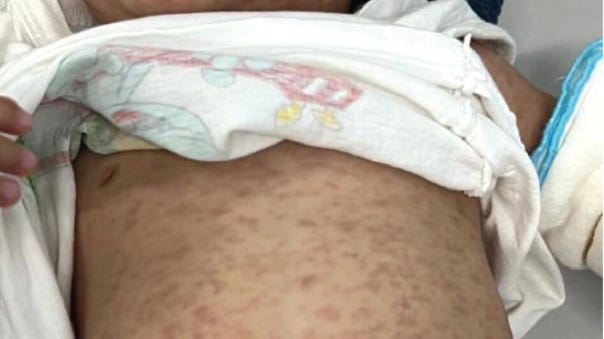
Measles presents distinct clinical features: Koplik spots on the buccal mucosa signal its onset, followed by a rash spreading from the trunk to the limbs. Conjunctivitis and fever mark its progression, with infectiousness peaking before day 4 post-rash and potential exposure as early as day 23 pre-symptoms. Beyond pneumonia, complications like diarrhea (30 per 100 cases) reveal measles’s multisystem impact, making it a compelling subject for studying viral pathogenesis.
The Vaccination Coverage Crisis
The article reveals a stark reality: 99% of 1500 countries analyzed had MMR coverage below 95% in 2023, fueling outbreaks. The pandemic disrupted campaigns, with low- and middle-income countries hit hardest at 86% coverage. The call for randomized trials on vaccine patches holds promise for simpler delivery methods to enhance coverage, particularly in resource-limited settings. This is an exciting frontier for biotechnology and public health innovation.
Why Measles Matters in 2025
Measles’ ability to exploit immune vulnerabilities, coupled with vaccination challenges, makes it a persistent threat. The NEJM review recommends research into immune restoration, early vaccination, and novel delivery systems, such as vaccine patches. This is a rallying cry for scientists, policymakers, and health advocates to unite for a future free from measles. By leveraging these insights, we can drive innovation and protect communities worldwide.
https://www.nejm.org/doi/full/10.1056/NEJMra2504516
#Measles #Immunology #eswark #drugdevelop