

I wanted to share a quick note: while I typically skip citations in my blogs, I’m making an exception this time! Why, you ask? It's because many of my sources come from websites that might change their content over time.
The journey of a new drug from the laboratory bench to the patient's bedside is notoriously long and expensive. However, the U.S. Food and Drug Administration (FDA) is now championing a transformative shift, positioning artificial intelligence (AI) not merely as a technology it regulates in industry, but as a powerful tool to be wielded within its walls. This dual embrace of AI, particularly since early 2025, signals a new chapter in public health innovation, aiming to make drug development and review smarter, faster, and ultimately more effective.
The agency's strategy is twofold: guiding the pharmaceutical industry on the responsible use of AI and simultaneously revolutionizing its internal processes through AI adoption. This approach suggests a future where regulatory frameworks are shaped by hands-on experience with the technologies being overseen.
The Regulatory Compass: FDA's January 2025 AI Guidance for Industry
A pivotal moment in this journey arrived on January 7, 2025, with the release of the FDA's draft guidance, "Considerations for the Use of Artificial Intelligence to Support Regulatory Decision Making for Drug and Biological Products".2 This document offers the industry a much-anticipated roadmap for integrating AI-generated data into submissions concerning drug safety, effectiveness, and quality.
FDA defines AI broadly as "a machine-based system that can, for a given set of human-defined objectives, make predictions, recommendations, or decisions influencing real or virtual environments.".2
Notably, the guidance focuses on AI applications that directly impact these regulatory endpoints, rather than earlier-stage drug discovery or operational efficiencies that do not have a direct bearing on patient safety or study reliability.3
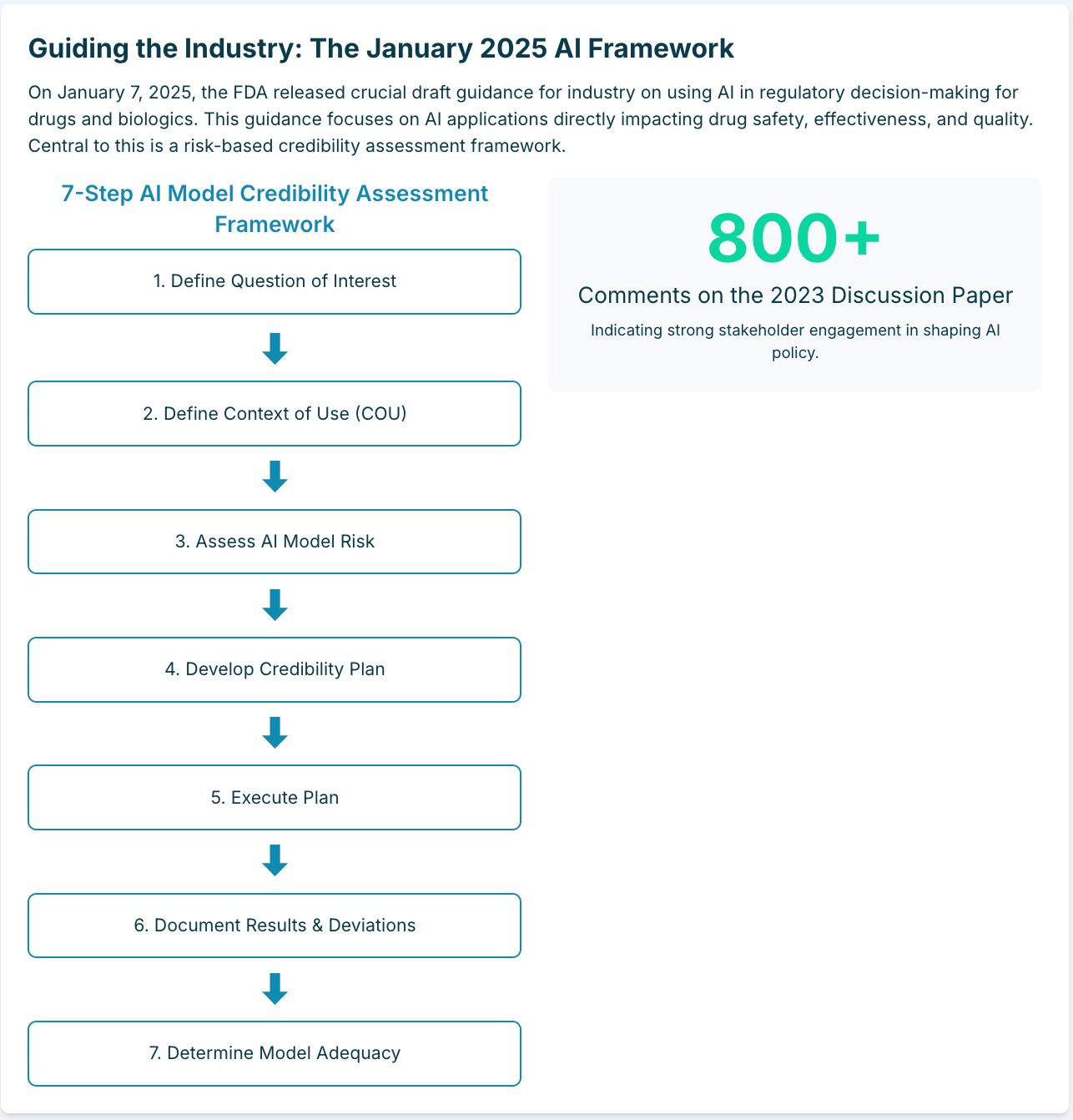
At the heart of this guidance is the risk-based credibility assessment framework. This structured, seven-step process tailors the level of scrutiny and evidentiary requirements to the potential risk an AI model poses within its specific application, or Context of Use (COU).3 The COU is critical: the FDA evaluates AI models not in isolation but based on how their outputs influence regulatory decisions.3 For instance, an AI model that is the sole determinant for whether a clinical trial participant receives more rigorous safety monitoring would be deemed high risk. In contrast, an AI system used to direct vial fill volumes during manufacturing, but which includes human batch checks, might be considered medium risk due to lower model influence despite potentially high consequences of error.3
This framework signifies a proactive regulatory stance. Developed through extensive consultation, including an expert workshop in December 2022 and feedback from over 800 comments on a 2023 discussion paper 2, the guidance aims to shape responsible AI development in the pharmaceutical sector. By setting clear, albeit evolving, expectations, the FDA seeks to foster innovation while mitigating risks, potentially reducing regulatory uncertainty for sponsors.
Figure 1: FDA's 7-Step AI Model Credibility Assessment Framework
Source: 4
An Agency Transformed: FDA's Internal AI Revolution
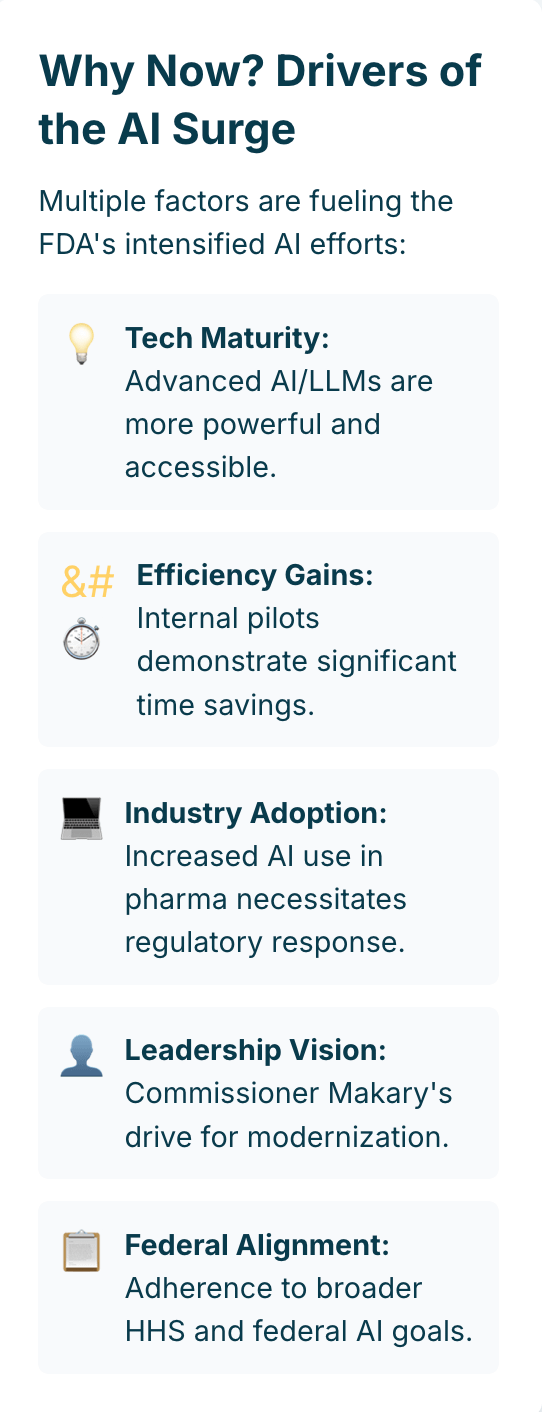
The FDA is transforming with AI. On May 8, 2025, Commissioner Martin A. Makary announced the completion of the agency's first AI-assisted scientific review pilot and plans to implement generative AI tools by June 30, 2025.6.
"I was blown away by the success of our first AI-assisted scientific review pilot," stated Commissioner Makary. "We need to value our scientists’ time and reduce the amount of non-productive busywork that has historically consumed much of the review process. The agency-wide deployment of these capabilities holds tremendous promise in accelerating the review time for new therapies".7 He further emphasized the urgency: "It is time to take action. The opportunity to reduce tasks that once took days to just minutes is too important to delay".7
Commissioner Makary
Leading this rollout are Jeremy Walsh, the FDA's Chief AI Officer, and Sridhar Mantha, former head of CDER's Office of Business Informatics.6 Adding a significant dimension to this evolving landscape is the May 2025 appointment of Dr. Vinay Prasad as the new Director of the Center for Biologics Evaluation and Research (CBER).10 Dr. Prasad, a hematologist-oncologist and professor of epidemiology, is known for his rigorous approach to medical evidence and has been described as a "vocal critic of the FDA" while also being a "rigorous and professional cancer research methodology expert".11 He has previously voiced concerns about aspects of the FDA's accelerated approval pathways.15
CBER oversees the regulation of biologics, including many innovative therapies like gene and cell therapies, where AI is expected to play an increasingly crucial role. Dr. Prasad's known emphasis on high evidentiary standards could shape how AI-driven data is evaluated for these complex products. While CBER will undoubtedly leverage AI tools, his leadership may ensure that an exacting demand for robust validation of AI-derived evidence balances the push for efficiency.
The Path to 2025: A History of FDA's Growing AI Engagement
The FDA's current AI initiatives are not an overnight phenomenon, but rather the culmination of years of groundwork and accumulated experience, especially within the Center for Drug Evaluation and Research (CDER). This center has witnessed a "significant increase in the number of drug application submissions using AI components over the past few years".2 Crucially, CDER gained experience with over 500 submissions incorporating AI components between 2016 and 2023, a rich dataset of real-world applications that directly informed the January 2025 guidance.2
The AI Tightrope: Balancing Benefits and Burdens for Drug Developers
The FDA's AI initiative presents a complex calculus of opportunities and challenges for pharmaceutical sponsors.
Potential Benefits:
The most direct advantage could be accelerated review timelines if the FDA's internal AI efficiencies translate into faster decision-making.6 The January 2025 guidance aims to provide clearer regulatory pathways, reducing ambiguity for sponsors incorporating AI.2 AI itself offers powerful tools to enhance innovation, enabling sponsors to analyze vast datasets for novel drug candidates, optimize clinical trial designs, and advance personalized medicine.3 Furthermore, AI can help extract improved data insights from complex information, potentially leading to more robust and persuasive regulatory submissions.18
Potential Harms and Challenges:
Significant concerns revolve around the transparency and explainability of AI models. The "black box" nature of some algorithms can make it difficult for sponsors to understand or contest AI-generated findings, whether from their own models or potentially from the FDA's internal review tools.6 Data security and confidentiality are paramount, especially if the FDA's internal generative AI tools are trained on broad datasets that might include proprietary information from multiple sponsors.6 Sponsors must remain vigilant in protecting their confidential commercial information and trade secrets.6
Algorithmic bias is another critical challenge. AI models trained on non-representative datasets can perpetuate or even amplify biases, potentially affecting drug safety and efficacy assessments across diverse demographic groups.4 Sponsors bear the primary responsibility for identifying and mitigating such biases in their AI systems. The costs of validation and compliance with the FDA's credibility assessment framework—including ensuring data quality, rigorous model validation, and comprehensive documentation—will require substantial investment from sponsors.3 Finally, the dynamic nature of AI necessitates robust lifecycle management. Models can experience "drift" as data inputs change over time, necessitating continuous monitoring, revalidation, and potential retraining to ensure they remain suitable for their intended purpose, thereby adding to long-term operational burdens.4
The FDA's AI initiative thus presents a classic risk-reward scenario. The allure of accelerated innovation and streamlined processes is substantial, but it is accompanied by new layers of complexity, responsibility, and cost for drug developers.
Best Practices for AI-Powered Submissions
For pharmaceutical sponsors navigating this new AI-driven regulatory terrain, several best practices emerge from the FDA's communications and guidance:
Early and Ongoing Engagement with FDA: This is repeatedly emphasized as crucial. Proactive discussions with the agency about AI model risk, the proposed credibility assessment plan, and potential challenges can de-risk the submission process and align expectations.3 The guidance "strongly encourages sponsors... to engage early with FDA".23
Master the Credibility Assessment Framework: A thorough understanding and meticulous application of the FDA's 7-step framework is essential.4 This framework is the agency's primary tool for evaluating AI in submissions.
Prioritize Data Quality, Governance, and Representativeness: The foundation of any credible AI model is high-quality data. Sponsors must ensure that datasets used for training, tuning, and validation are relevant, reliable, and representative of the intended patient population to avoid introducing or perpetuating bias.4
Transparency in Model Development and Documentation: Comprehensive documentation is key. This includes detailing the AI model's architecture, the development process, data sources and preprocessing steps, performance metrics, and known limitations.3
Robust Validation and Lifecycle Performance Monitoring: Rigorous validation is necessary to demonstrate the AI model's safety and effectiveness, including performance across relevant subgroups. A plan for ongoing lifecycle management, including monitoring for performance degradation or data drift, is also expected.4
Address Cybersecurity: AI systems can introduce unique cybersecurity vulnerabilities. Sponsors must implement robust measures to protect data integrity and system security.21
Success in this evolving landscape demands a paradigm shift for sponsors towards greater transparency, more rigorous data stewardship, and a continuous, lifecycle-oriented approach to AI model governance. The FDA is effectively promoting "Good Machine Learning Practice" (GMLP) as a standard in drug development, analogous to existing standards like Good Clinical Practice (GCP) and Good Manufacturing Practice (GMP).28
Insights for pharmaceutical innovators
Artificial intelligence holds undeniable potential to revolutionize drug development and the field of regulatory science. The FDA's initiatives in 2025 mark a decisive and bold stride towards harnessing this power, moving the agency into a new era of technological sophistication. This endeavor is more than a mere upgrade of tools; it represents a fundamental rethinking of how therapeutic innovations are evaluated and delivered to the public.
This journey is exciting and ever-changing! The FDA's frameworks and internal practices will surely evolve as technology advances and we gain more experience. It’s essential for everyone—agencies, industry, academic researchers, and patient advocacy groups—to collaborate in navigating the complexities that lie ahead. The FDA's proactive and flexible approach to AI regulation can inspire other regulatory bodies worldwide as they tackle the integration of artificial intelligence into vital sectors, all with the goal of improving public health in a rapidly advancing scientific landscape.
Works cited
Remarks by FDA Commissioner Robert M. Califf to the Coalition for Health AI (CHAI) - 03/05/2024, accessed May 29, 2025, https://www.fda.gov/news-events/speeches-fda-officials/remarks-fda-commissioner-robert-m-califf-coalition-health-ai-chai-03052024
Artificial Intelligence for Drug Development - FDA, accessed May 29, 2025, https://www.fda.gov/about-fda/center-drug-evaluation-and-research-cder/artificial-intelligence-drug-development
The Role of AI in Regulatory Decision-Making for Drugs & Biologics: the FDA's Latest Guidance | WCG, accessed May 29, 2025, https://www.wcgclinical.com/insights/the-role-of-ai-in-regulatory-decision-making-for-drugs-biologics-the-fdas-latest-guidance/
Exploring the FDA's draft guidance on AI in regulatory decision-making - Boyd Consultants, accessed May 29, 2025, https://boydconsultants.com/exploring-the-fdas-draft-guidance-on-ai-in-regulatory-decision-making/
FDA AI Guidance - A New Era for Biotech, Diagnostics and Regulatory Compliance, accessed May 29, 2025, https://www.duanemorris.com/alerts/fda_ai_guidance_new_era_biotech_diagnostics_regulatory_compliance_0225.html
FDA advances AI-powered review of medical product applications - Hogan Lovells, accessed May 29, 2025, https://www.hoganlovells.com/en/publications/fda-advances-aipowered-review-of-medical-product-applications
FDA Announces Completion of First AI-Assisted Scientific Review ..., accessed May 29, 2025, https://www.fda.gov/news-events/press-announcements/fda-announces-completion-first-ai-assisted-scientific-review-pilot-and-aggressive-agency-wide-ai
FDA commissioner talks of shortening drug approval process, benefits of AI | AHA News, accessed May 29, 2025, https://www.aha.org/news/headline/2025-05-06-fda-commissioner-talks-shortening-drug-approval-process-benefits-ai
FDA AI deployment: Innovation vs oversight in drug regulation - AI News, accessed May 29, 2025, https://www.artificialintelligence-news.com/news/fda-ai-deployment-innovation-vs-oversight-drug-regulation/
FDA CBER Director Dr. Vinay Prasad to Keynote NORD's Inaugural Rare Disease Scientific Symposium, Convening Top Researchers, Industry Leaders, and Federal Regulators, accessed May 29, 2025, https://rarediseases.org/fda-cber-dr-vinay-prasad-keynote-nords-rare-disease-scientific-symposium/
This Week at FDA: Makary names Vinay Prasad to lead CBER, more high-level hirings and departures | RAPS, accessed May 29, 2025, https://www.raps.org/news-and-articles/news-articles/2025/5/this-week-at-fda-makary-names-vinay-prasad-to-lead
Vinayak Prasad - FDA, accessed May 29, 2025, https://www.fda.gov/about-fda/fda-organization/vinayak-prasad
FDA to Restrict Future COVID-19 Vaccine Recommendations to Older Adults, High-Risk Groups - Pharmacy Times, accessed May 29, 2025, https://www.pharmacytimes.com/view/fda-to-restrict-future-covid-19-vaccine-recommendations-to-older-adults-high-risk-groups
FDA sets COVID vaccine formula as RFK Jr. narrows guidance for shots | BioPharma Dive, accessed May 29, 2025, https://www.biopharmadive.com/news/fda-covid-vaccines-guidance-narrow-strain-recommendation/748975/
Makary's 'Conditional Approval' Pathway for Rare Diseases Poses More Questions Than Answers - BioSpace, accessed May 29, 2025, https://www.biospace.com/fda/makarys-conditional-approval-pathway-for-rare-diseases-poses-more-questions-than-answers
FDA leaders seek industry input on 'listening tour' - BioPharma Dive, accessed May 29, 2025, https://www.biopharmadive.com/news/makary-fda-listening-tour-pharma-industry-ceos/749140/
FDA Announces Completion of AI-Assisted Scientific Review Pilot and Deployment of Agency-Wide AI-Assisted Review - King & Spalding, accessed May 29, 2025, https://www.kslaw.com/news-and-insights/fda-announces-completion-of-ai-assisted-scientific-review-pilot-and-deployment-of-agency-wide-ai-assisted-review
Unearthing the FDA's Treasure Trove: Using AI to Revolutionize Drug Development, accessed May 29, 2025, https://globalforum.diaglobal.org/issue/april-2025/unearthing-the-fdas-treasure-trove-using-ai-to-revolutionize-drug-development/
Harnessing the AI/ML in Drug and Biological Products Discovery and Development: The Regulatory Perspective - MDPI, accessed May 29, 2025, https://www.mdpi.com/1424-8247/18/1/47
NHC Submits Comments on FDA Draft Guidance on AI to Support Regulatory Decision-Making for Drugs/Biologics - National Health Council, accessed May 29, 2025, https://nationalhealthcouncil.org/letters-comments/nhc-submits-comments-on-fda-draft-guidance-on-ai-to-support-regulatory-decision-making-for-drugs-biologics/
FDA Issues Draft Guidance for AI-Enabled Devices: Key Takeaways - Dentons, accessed May 29, 2025, https://www.dentons.com/en/insights/alerts/2025/february/11/fda-issues-draft-guidance-for-ai-enabled-devices
AI Health Law & Policy: FDA's rapidly evolving regulatory paradigms - Hogan Lovells, accessed May 29, 2025, https://www.hoganlovells.com/en/publications/ai-health-law-policy-fda%E2%80%99s-rapidly-evolving-regulatory-paradigms
AI in drug development: FDA draft guidance addresses product lifecycle, risk | RAPS, accessed May 29, 2025, https://www.raps.org/news-and-articles/news-articles/2025/1/ai-in-drug-development-fda-draft-guidance-addresse
Key takeaways from FDA's draft guidance on use of AI in drug and biological life cycle, accessed May 29, 2025, https://www.dlapiper.com/insights/publications/2025/01/fda-releases-draft-guidance-on-use-of-ai
The Biden Administration's Swan Song on Digital Health: Two FDA Guidances on Artificial Intelligence and FDA's Defense of its Clinical Decision Support Guidance | Insights | Ropes & Gray LLP, accessed May 29, 2025, https://www.ropesgray.com/en/insights/alerts/2025/01/the-biden-administrations-swan-song-on-digital-health
FDA Issues Draft Guidances on AI in Medical Devices, Drug Development - Fenwick, accessed May 29, 2025, https://www.fenwick.com/insights/publications/fda-issues-draft-guidances-on-ai-in-medical-devices-drug-development-what-manufacturers-and-sponsors-need-to-know
FDA unveils long-awaited guidance on AI use to support drug and biologic development, accessed May 29, 2025, https://www.hoganlovells.com/en/publications/fda-unveils-longawaited-guidance-on-ai-use-to-support-drug-and-biologic-development
The Evolving FDA Regulatory Landscape of Artificial Intelligence - Gardner Law, accessed May 29, 2025, https://gardner.law/news/theevolving-fda-regulatory-landscape-of-artificial-intelligence
Navigating FDA Compliance for AI-Powered Healthcare Tools and EHRs, accessed May 29, 2025, https://hypersense-software.com/blog/2025/04/04/navigating-fda-compliance-ai-healthcare-ehrs/
#FDA #AIinHealthcare #RegulatoryGuidance #DrugDevelopment #FDAGuidance
#FutureofMedicine #RegulatoryAffairs #AIgovernance #sensiblemedicine